Bibliography
Identity
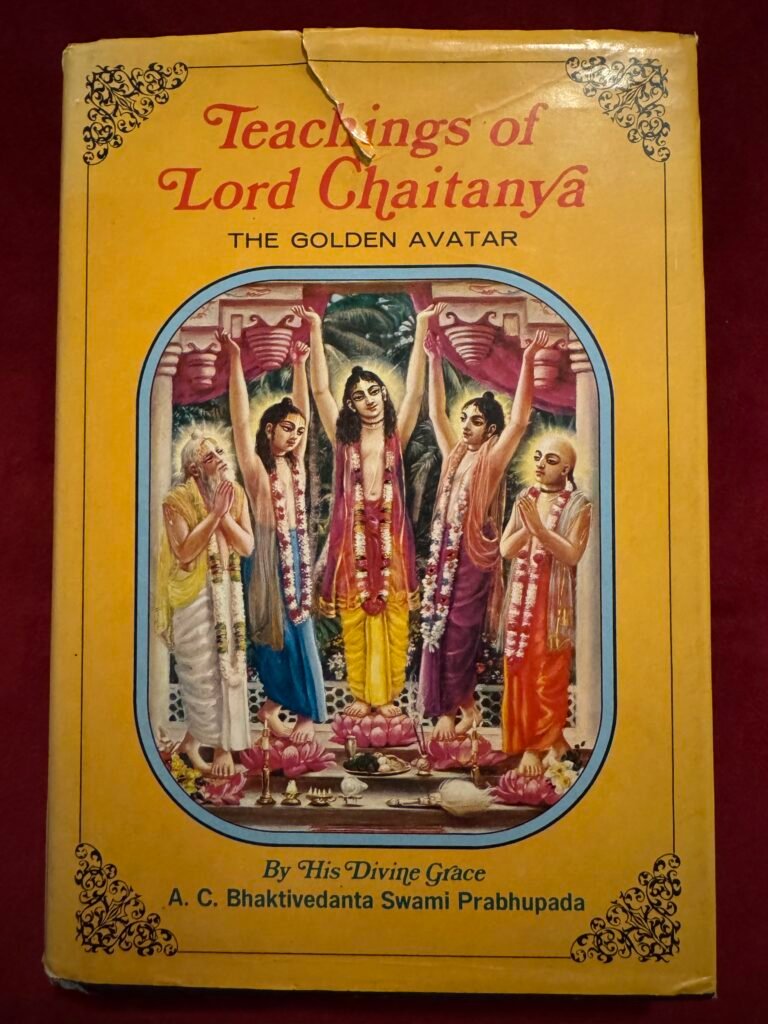
Title & Subtitle: Teachings of Lord Chaitanya: A Treatise on Factual Spiritual Life
Year of Publication: 1972
Publisher & Location: The Bhaktivedanta Book Trust (BBT); New York, Los Angeles, London.
Edition & Printing State: First Edition, Sixth Printing. (The copyright page will typically show a string of numbers or explicitly state “Sixth Printing, 1972”).
ISBN/LCCN: LCCN: 68-29320.Note: Even though it is 1972, it retains the original 1968 LCCN. It may also feature the early ISBN: 0-912776-07-3.
Physical Description
Binding: Hardcover. Usually dark blue or navy cloth with gold foil stamping. By the sixth printing, the quality of the cloth and the “tightness” of the binding were more standardized than the 1968 Tokyo run.
Dust Jacket Points: * Price: Often reflects a slight increase or a “sticker price” depending on the distributor, but $5.95 remained common.
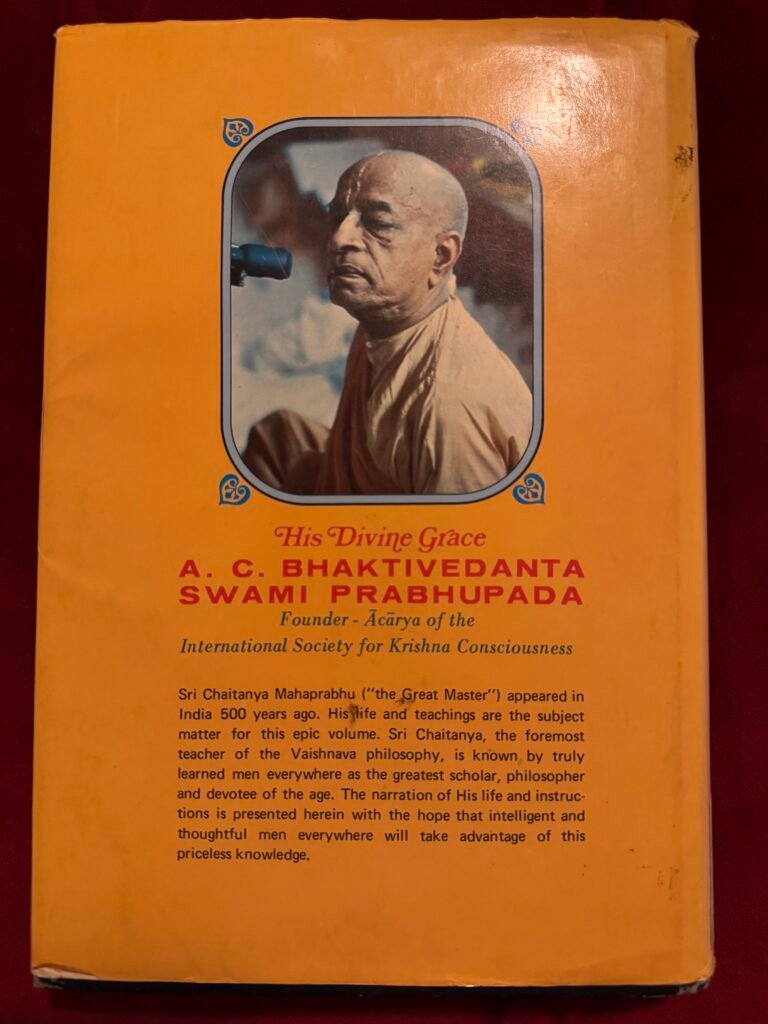
Back Cover: Typically features a list of other available titles by Srila Prabhupada, including the newly released Bhagavad-gita As It Is (1972) and Krsna Book.
Page Count: v + 292 pp. (Main text remains consistent with the 1968 layout).
Illustrations: Features the standard color plates. By 1972, the printing quality of these plates had been refined, resulting in more vibrant colors compared to the slightly more “muted” 1968 first printing.
Collector “Points”
The “Transition” Copy: This printing is a bridge. It maintains the original “Hayagriva-edited” text (with all the “therefores” and original phrasing) but is physically packaged as a BBT product.
Errors/Typos: By the sixth printing, many of the blatant “printer’s errors” from the 1968 first Japan run had been corrected, but the Indo-English vocabulary and original spellings (like “Bhagwatam”) were still intact.
The BBT Logo: Look for the Bhaktivedanta Book Trust logo (the lotus with the book and lamp) on the spine and title page. The 1968 edition used the earlier “ISKCON Press” logo or simple text.
Endpapers: Some 1972 printings began using more decorative or higher-quality endpapers compared to the plain white ones found in the earliest 1968 copies.
Did you know?
The 1972 sixth printing is often cited by “Original Books” enthusiasts as the “Peak Edition.” It is the most polished version of the book that still contains 100% of the original editorial content before the 1974 revision changed the text significantly.
Background
The 1972 Sixth Printing of Teachings of Lord Chaitanya is often regarded by bibliophiles and scholars as the “definitive” version of the original manuscript. It represents the height of the book’s production quality before the controversial 1974 textual revisions.
The History: From ISKCON Press to the BBT
By 1972, the “Blue TLC” had become a staple of the movement, but the infrastructure behind it had changed completely.
The Birth of the BBT: This printing coincided with the formalization of the Bhaktivedanta Book Trust (BBT) in 1972. While the 1968 edition was a grassroots effort by a few disciples in a storefront, the 1972 edition was backed by a global legal trust designed to keep Prabhupada’s books in print “forever.”
The “Golden Era” of Distribution: 1972 was the year that large-scale book distribution in airports and public spaces began in earnest. This sixth printing was the very book that thousands of people first encountered when they met the “Hare Krishnas” during the early 70s counter-culture peak.
The “Last Call” for the Original Text
The 1972 printing is essentially the final “clean” copy of the original Hayagriva-edited text.
Trivia: In 1974, the BBT decided to “standardize” all of Prabhupada’s books. This 1972 version is the last time you see the original, more complex sentence structures and idiosyncratic vocabulary (like the consistent use of “therefore” to drive home philosophical points) before they were edited for a more “modern” reading level.
The Tokyo to Los Angeles Shift
While the 1968 first printing was a product of Tokyo, the 1972 printings moved closer to home.
Trivia: As the movement grew, the BBT shifted production to domestic American printers to keep up with demand. Collectors often compare the paper stock of the 1972 USA printings to the 1968 Japan printings—the 1972 paper is often slightly thicker and whiter, giving the book a heavier, more “academic” feel in the hand.
The Logo Evolution
Look closely at the spine and the title page.
Trivia: This printing features the classic BBT “Lotus” logo in its most polished form. Earlier iterations of the logo were sometimes slightly off-center or used different line weights. The 1972 version established the branding that is still recognized globally today.
The “Bhagwatam” Spelling
Even in 1972, the book maintains the spelling “Bhagwatam” (with a ‘w’) rather than the now-standard “Bhagavatam.”
Trivia: This spelling is a direct link back to Srila Prabhupada’s original 1962 Delhi volumes. By 1974, the BBT moved to a stricter Sanskrit transliteration system, making the 1972 edition a linguistically unique “middle ground.”