Bibliography
Identity
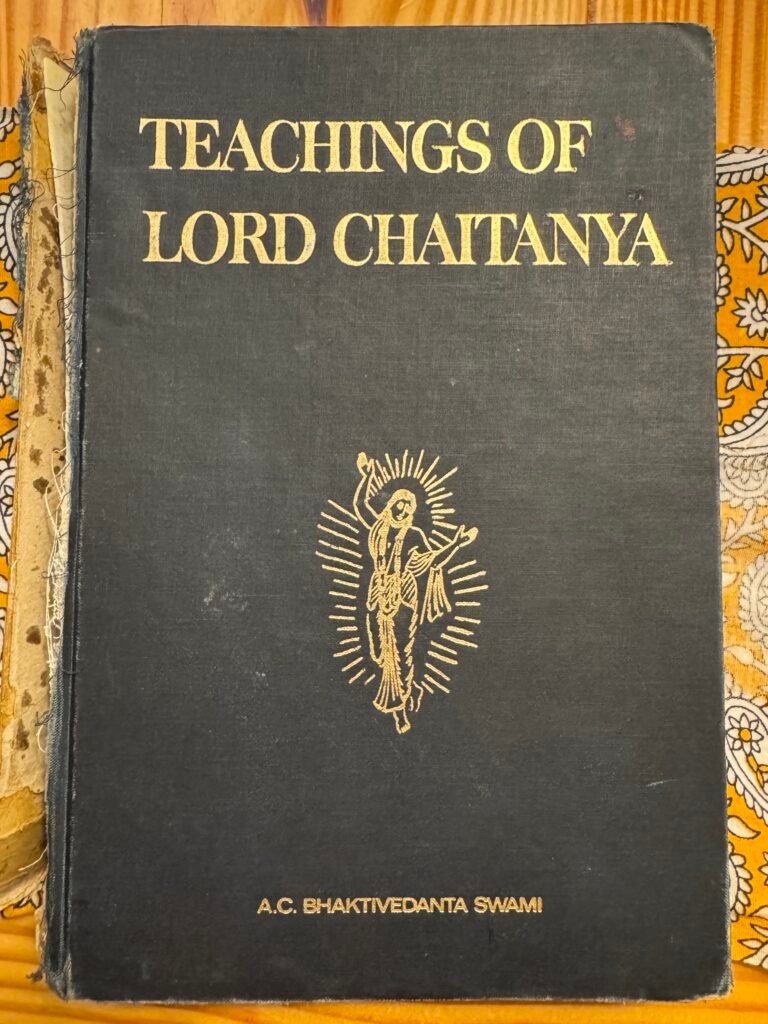
Title & Subtitle: Teachings of Lord Chaitanya: A Treatise on Factual Spiritual Life
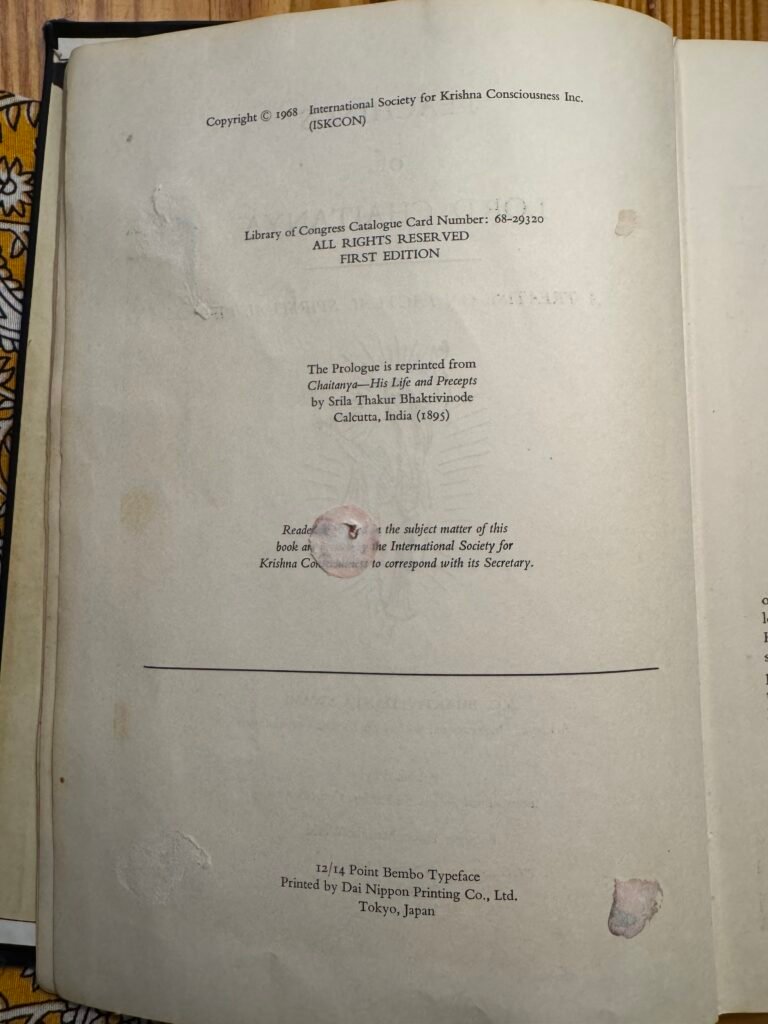
Year of Publication: 1968
Publisher & Location: International Society for Krishna Consciousness (ISKCON), New York City.
Edition & Printing State: First Edition, First Printing.
LCCN:68-29320
Note: In this era, ISKCON Press (Brooklyn) and Macmillan used similar LCCN sequences. Yours is the confirmed LCCN for the blue-cloth TLC.
Physical Description
Binding: Hardcover. Blue cloth with gold foil stamping on the spine and the front cover.
Dust Jacket Points:
Price: Original price usually listed as $5.95.
The “Golden Avatar” blurb: The jacket often features a prominent description of Lord Chaitanya as the “Golden Avatar.”
Page Count: Front matter + 292 pages of main text.
Illustrations: Includes color plates tipped into the book. These were some of the first professional reproductions of paintings by Jadurani Dasi and Govinda Dasi.
Collector “Points”
The Intro/Dedication: Look for the dedication page. It is famously dedicated to the “Sankirtan Movement” and the devotees pushing it forward.
Typography: The book was printed by Dai Nippon Printing Co. in Tokyo, Japan. You can find this credit at the bottom of the “A Note on the Type” or copyright page. It uses 12/14 Point Bembo typeface.
Editorial Style: This is the “unedited” version that many collectors prefer. It contains the original “therefore” sentence structures and specific “Prabhupada-isms” (like the spelling “Bhagwatam” with a ‘w’) that were standardized out of the 1974 edition.
The “Ginsberg” Connection: While the Gita has the famous blurb, early copies of TLC were often distributed alongside it in 1968–1969, and collectors often look for the matching blue cloth set.
Background
The “Prabhupada-Hayagriva” Collaboration
The most significant piece of history behind this edition is the direct personal involvement of the author and editor. In 1967 and 1968, Srila Prabhupada spent hundreds of hours in a small apartment in New York and later in San Francisco working directly with Hayagriva Dasa (Howard Wheeler).
- Trivia: Hayagriva was a professor of English with a background in poetry. Because the Teachings of Lord Chaitanya is a summary of the Chaitanya-charitamrta (a highly poetic work), Prabhupada specifically utilized Hayagriva’s “lyrical” style to make the philosophy accessible to the 1960s counter-culture.
- The “Therefore” Logic: This edition is famous for keeping Prabhupada’s original “scholastic” structure. Later editors (in 1974) removed the word “therefore” thousands of times to make the text “flow” better. However, Prabhupada later noted that he used “therefore” to denote a logical conclusion, and many collectors believe the 1968 version preserves his original “train of thought” better.
The “Delhi to Tokyo” Connection
While the book was compiled in New York, it was physically printed by Dai Nippon in Tokyo, Japan.
Trivia: In 1968, ISKCON didn’t have its own high-speed presses yet. This book represents the transition from the rough “Delhi-style” printing of Prabhupada’s early Indian volumes to a high-quality, professional Western format.
The Weight of History: This was the first “substantial” hardbound book produced by his disciples. When the first copies arrived from Japan, Prabhupada was reportedly overjoyed, seeing it as proof that his movement was becoming a serious global force.
The “Missing” Artwork & Dedication
Your 1968 copy contains elements that were permanently removed in later versions:
The Acknowledgments: This edition features a personal “Acknowledgements” section where Prabhupada personally thanks his early disciples—Rayarama, Satsvarupa, and Madhusudana—for their help with the manuscript. In the 1974 edition, this section was largely scrubbed or replaced by a generic BBT preface.
Original Art: The 1968 edition contains specific line drawings and color plates overseen by Govinda Dasi. There is a famous story that Prabhupada was later distressed when he found out that these original drawings, which he had personally approved, were replaced in later years by “more professional” but less personally-vetted art.
Linguistic “Time Capsule”
The 1968 TLC is a “time capsule” of early ISKCON terminology:
“Bhagwatam”: You will notice the spelling of Srimad-Bhagavatam is often rendered as “Bhagwatam.” This was the spelling Prabhupada used in his original 1962 Indian printings.
“The Swamiji”: The dust jacket refers to Prabhupada as “The Swamiji,” reflecting the era before the title “Srila Prabhupada” became the standard way for his disciples to address him (which happened around 1969–1970).
This edition is famous for featuring what many consider the “pioneer style” of ISKCON art—paintings created under intense pressure and direct guidance from Srila Prabhupada.
The Artists of the 1968 First Edition
The primary artists whose work appears in the color plates of your copy are:
- Jadurani Dasi (Judy Koslofsky): Often called the “mother” of ISKCON art. She was the most prolific artist during the New York/Brooklyn years. Her style in 1968 was evolving rapidly under Prabhupada’s daily instruction to “make the figures look like they are in the spiritual world.”
- Govinda Dasi (Joan Campanella): She was responsible for the line drawings throughout the book and oversaw the artistic layout. Her work is distinctive for its delicate, almost “woodcut” feel.
- Baradraj Dasa: He contributed to the early “Golden Age” paintings. His work often focused on the details of the environment and the luminosity of the figures.
- Murali-dhara Dasa: Though he became more prominent in the 1970s, his early collaborative work began to appear during this transition to the 1968/1969 printings.
The “Paint-by-Instruction” Method In 1968, these artists weren’t just “interpreting” the text. Prabhupada would often stand behind them as they painted, telling them exactly which colors to use for Lord Chaitanya’s complexion (molten gold) and how many arms or ornaments a figure should have. When you look at the plates in your copy, you are seeing the result of direct, face-to-face instruction.
The Lost Line Drawings The black and white line drawings by Govinda Dasi are a hallmark of the 1968 printing. In later BBT editions (starting in 1974), these were completely removed or replaced with standard photographs or newer oil paintings. For collectors, these drawings represent the “heart” of the early movement’s aesthetic.
The Cover Art Mystery The painting on the dust jacket (Lord Chaitanya and his associates in sankirtana) was a group effort. Unlike modern art where one person claims the work, these early paintings were often communal—one person might paint the hands, another the background, and another the faces—all as a form of “Bhakti Yoga.”
If you check the credit page (usually near the back or on the copyright page), the 1968 edition is one of the few to give full-page credits to the artists. In later “scholarly” versions, these credits were often tucked into small font at the bottom of the plates or removed entirely to maintain a more academic look.