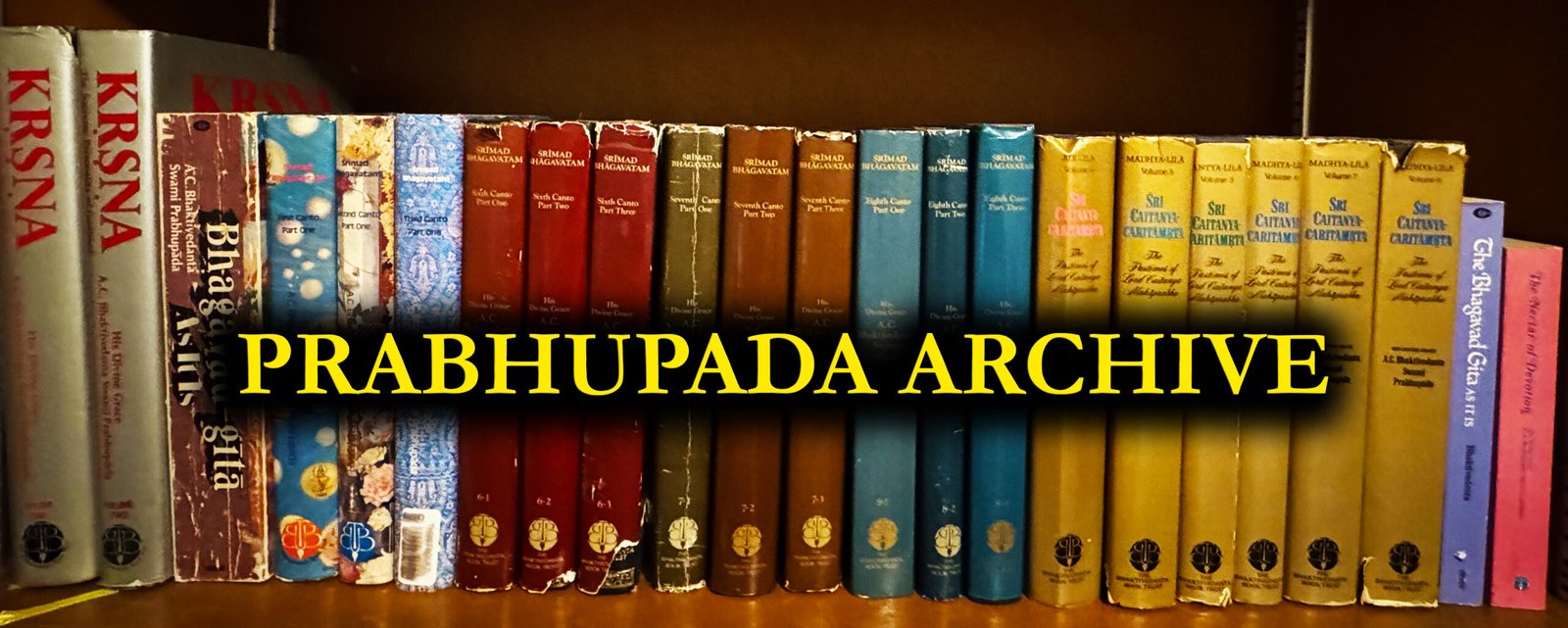
The 1968 abridged Macmillan edition of Bhagavad-gītā As It Is is a landmark in the history of the Hare Krishna movement, representing Srila Prabhupada’s first major breakthrough into the Western publishing world.
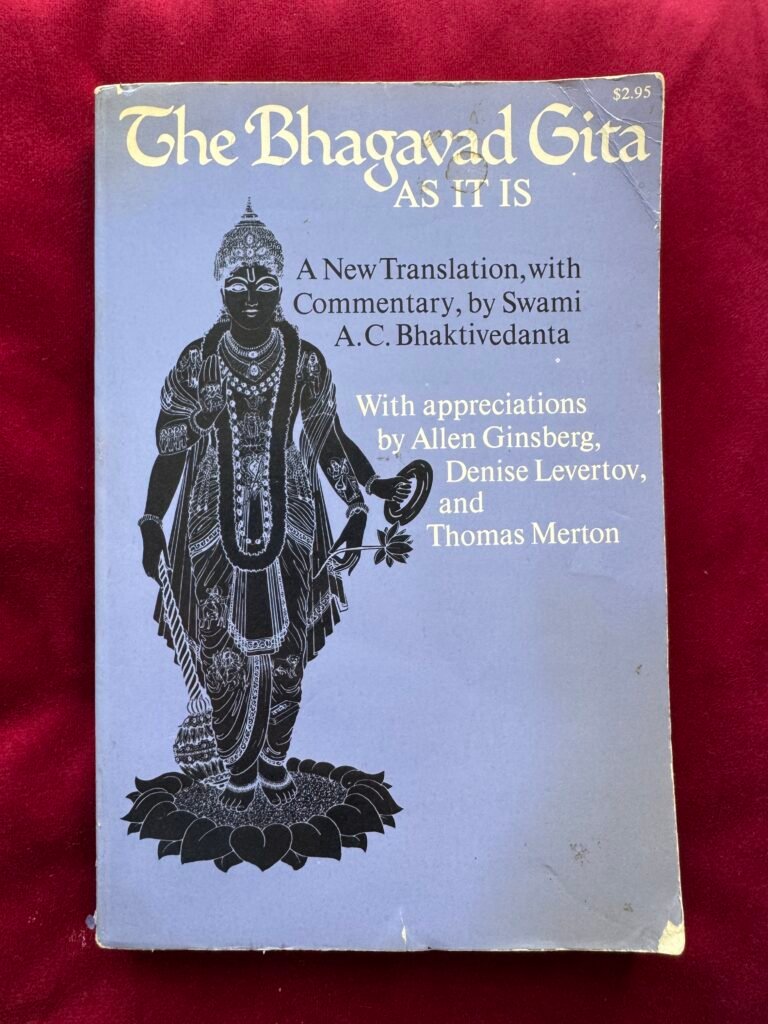
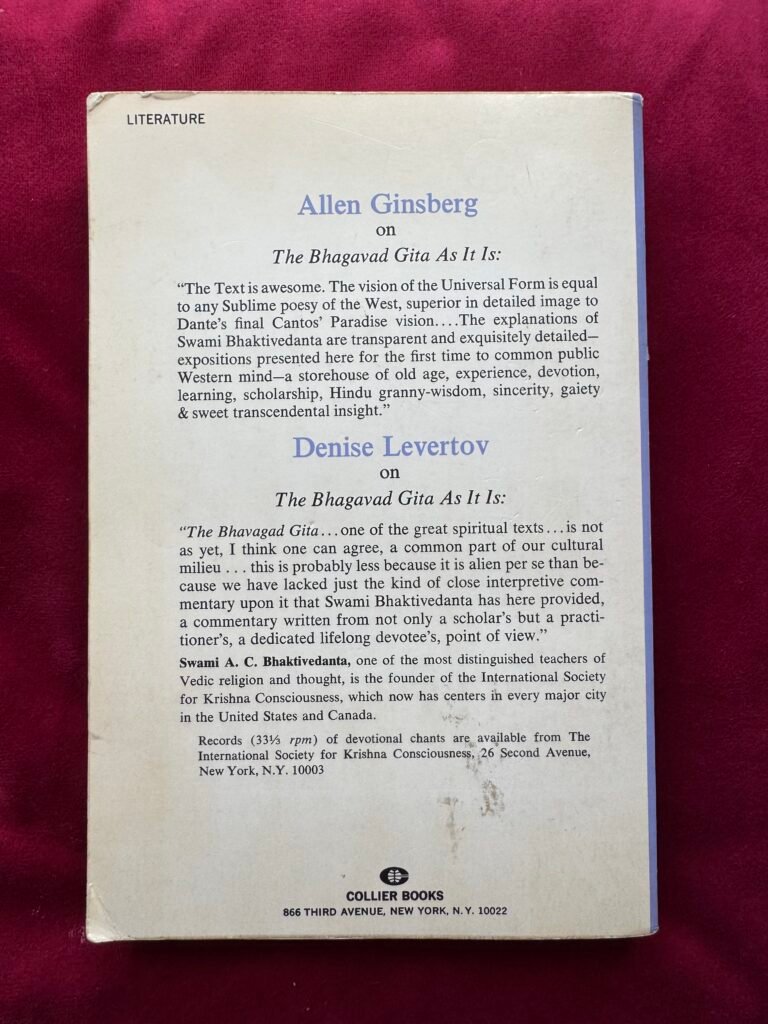
Pictured above: Bhagavad-gita As It Is 1968 Abridged Edition, First Printing 1968.
Below we present scans of the first pages and introduction of the Bhagavad-gita As It Is 1968 Abridged Edition, First Printing 1968
Bibliography
Title & Subtitle: The Bhagavad-Gita As It Is: A New Translation with Commentary
Year of Publication: 1968 (Look for “First Printing” or “First Collier Books Edition 1968” on the copyright page).
Publisher & Location: The Macmillan Company, New York / Collier Books, New York.
Edition & Printing State: First Edition 1968, First Printing 1968. Note: The paperback is often the “First Collier Books Edition.” The hardcover is the “First Macmillan Edition.”
ISBN/LCCN: * LCCN: 68-8322 (This is the primary identifier for the 1968 edition).ISBN: No ISBN was assigned to the very first print run, though later 1960s reprints use 0020835507.
Binding: * Paperback: Lavender/Purple “Collier Books” edition with a smooth matte finish.
Hardcover: Often bound in a dark cloth (usually tan or grey) with a dust jacket.
Dust Jacket Points: * The original price on the flap of the hardcover was typically $6.95 (or $2.95 for the paperback).Look for the Macmillan logo on the spine and the lack of a “BBT” logo.
Page Count: xviii + 318 pp.
Illustrations: * None in the text: Unlike the 1972 edition, the 1968 abridged version typically lacks the glossy color plates.
Cover Art: Features a four-armed Vishnu. The artist is Govinda Dasi, though she is often uncredited in this specific printing.
Check for the “Appreciations” page in the front—it includes quotes from Allen Ginsberg and Thomas Merton that were removed or shortened in many later editions to make the book more “orthodox.”
Errors/Typos: * The “Pitris” Correction: On page 266 (Chapter 9, Verse 25), the text famously says “the planet of the trees” instead of “the planet of the Pitris” (ancestors). Srila Prabhupada requested this specific correction for future editions.
Changes in Artwork: * The cover art is a “cropped” version of the Universal Form. Macmillan editors removed the thousands of heads and arms to make it a standard four-armed Vishnu.
Provenance Notes: * This is the version distributed during the “San Francisco/Haight-Ashbury” era.
Background
The Path to Publication (1966–1968)
Upon arriving in New York in 1965, Srila Prabhupada made the publication of the Bhagavad-gītā a top priority. He had already written a 1,000-page manuscript, but the journey to printing was fraught with setbacks, including the theft of his typewriter and original tapes.
By 1967, his disciples began a vigorous search for a “big” publisher to give the book academic credibility. Early attempts by the poet Allen Ginsberg and various disciples were unsuccessful until Brahmananda Dasa hand-delivered a record album to Macmillan Publishers. During that visit, he discovered that the senior editor, James Wade, just so happened to be looking for a translation of the Gita to round out their new religion section. It was Krishna’s arrangement.
The “Abridgement” Controversy
Although Macmillan agreed to publish the work, they were hesitant about the commercial viability of a 1,000-page scholarly text from a relatively unknown author.
- The Mandate: Macmillan required the manuscript to be cut down to approximately 400 pages.
- The Editing: The task of “trimming it to the bone” was largely handled by Rayarama Dasa (with earlier foundational work by Hayagriva Dasa).
- The Losses: To meet the page count, Macmillan’s editors removed:
-
- The original Sanskrit Devanagari script.
-
- The word-for-word Sanskrit-to-English meanings.
-
- Over 60% of the Purports (commentaries), especially from the later chapters.
-
The “Sugar-Coated” Success
Released in late 1968 with a distinctive purple cover, the book featured high-profile appreciations from Thomas Merton, Allen Ginsberg, and later George Harrison.
Srila Prabhupada was not entirely happy with the “minimized” version, famously calling it a “sugar-coated pill” designed to get people interested without providing the full “medicine.” However, its massive success—selling through several printings in just a few years—proved to Macmillan that there was a hungry market for the philosophy. This success directly paved the way for the 1972 Unabridged Edition, which restored all the missing Sanskrit and elaborate commentaries.
Historical Significance
The 1968 edition is best understood as the “prospectus” of the movement—a version created for mass-market reach that eventually forced the doors open for the full, scholarly presentation of the Gita in 1972.
The 1968 Macmillan Abridged Edition of Bhagavad-gītā As It Is remains one of the most significant artifacts for any researcher of Srila Prabhupada’s literary legacy. While it was the book that introduced the world to his teachings, the “abridgment” process left several unique gaps in the text that weren’t resolved until the 1972 edition.
The “Missing” Purports
One of the most striking features of the 1968 edition is that several chapters were printed without any purports (commentaries) at all to save space.
-
- Chapter 12 (“Devotional Service”): In the 1968 edition, Srila Prabhupada noted in a 1971 letter that he had to go back and dictate the purports for this entire chapter specifically for the upcoming unabridged version, as they were largely absent or severely minimized in the 1968 release.
-
- The “Later Chapters” (13–18): Macmillan felt the philosophical repetition in the final six chapters was too heavy for a mainstream audience. Consequently, these chapters were stripped down almost entirely to just the English translations of the verses.
-
- Chapter 9 (“The Most Confidential Knowledge”): This chapter was also heavily affected. In March 1971, Prabhupada wrote to his secretary, Jayadvaita, saying: “I have dictated the missing purports from Chapter Nine and they are sent enclosed herewith.” This confirms that a significant portion of the most esoteric knowledge in the Gita was missing its explanation in the 1968 purple-cover book.
The 1968 “Press Release” Sentiment
While there isn’t a single “standard” press release text, the sentiment in Macmillan’s early marketing (and in the famous Thomas Merton foreword) was to present the book as:
“A unique and definitive translation that provides the first clear and accurate view of the Indian tradition of bhakti (devotion) for the Western world.”
Srila Prabhupada himself often used the Macmillan imprimatur as a point of pride in his letters from 1968, saying, “Macmillan Company, the biggest publisher in the world, they are taking interest… our point is: present Kṛṣṇa as it is.”