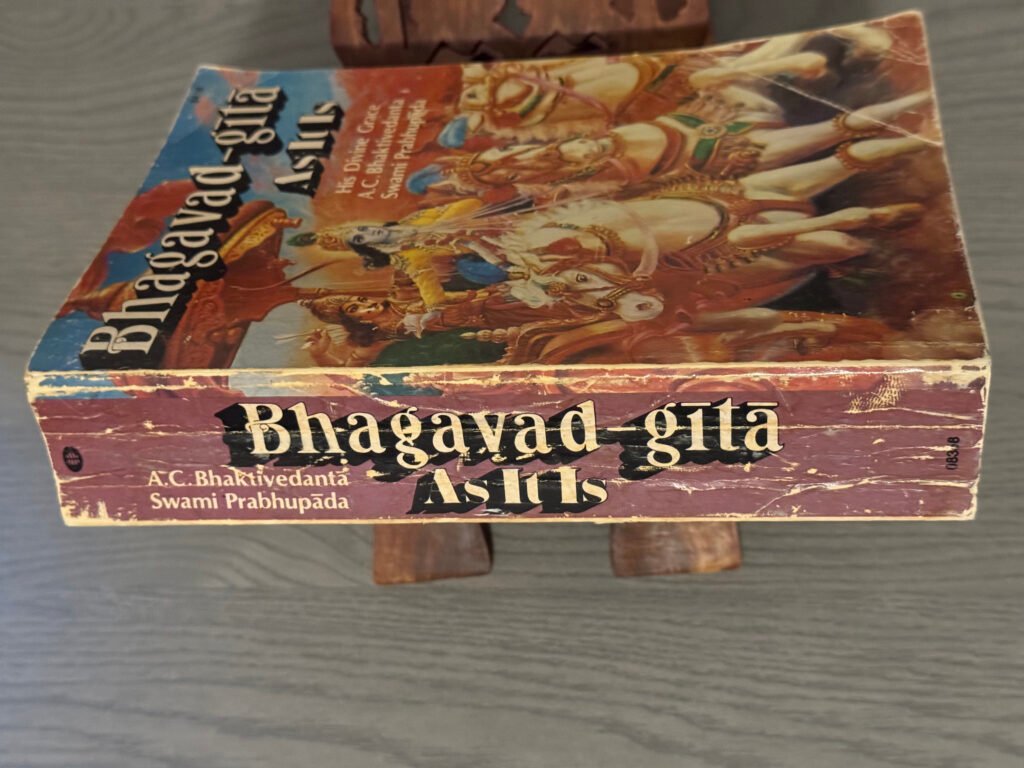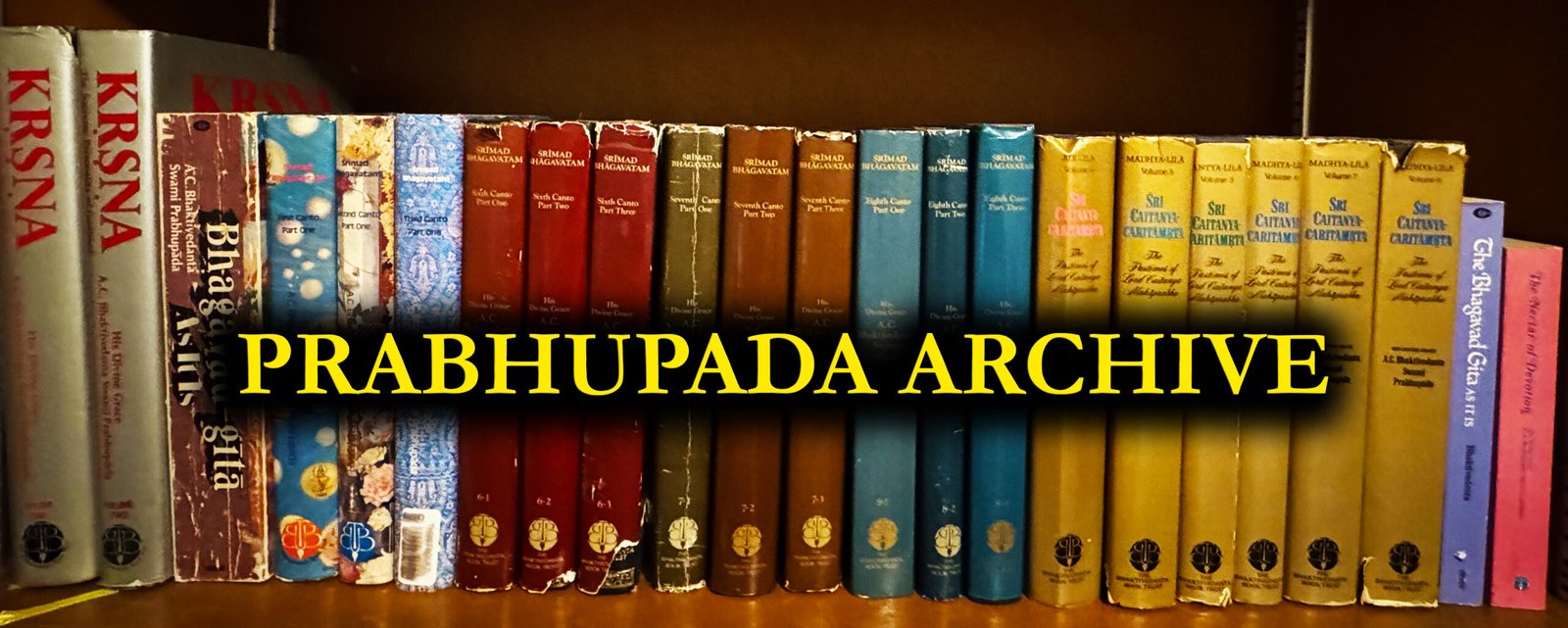
Bhagavad-gita As It Is 1972 Macmillan Edition, Paperback Fourth Printing 1973
Bibliography
Identifying
Title & Subtitle: Bhagavad-gītā As It Is: Complete Edition with original Sanskrit text, Roman transliteration, English equivalents, translation and elaborate purports.
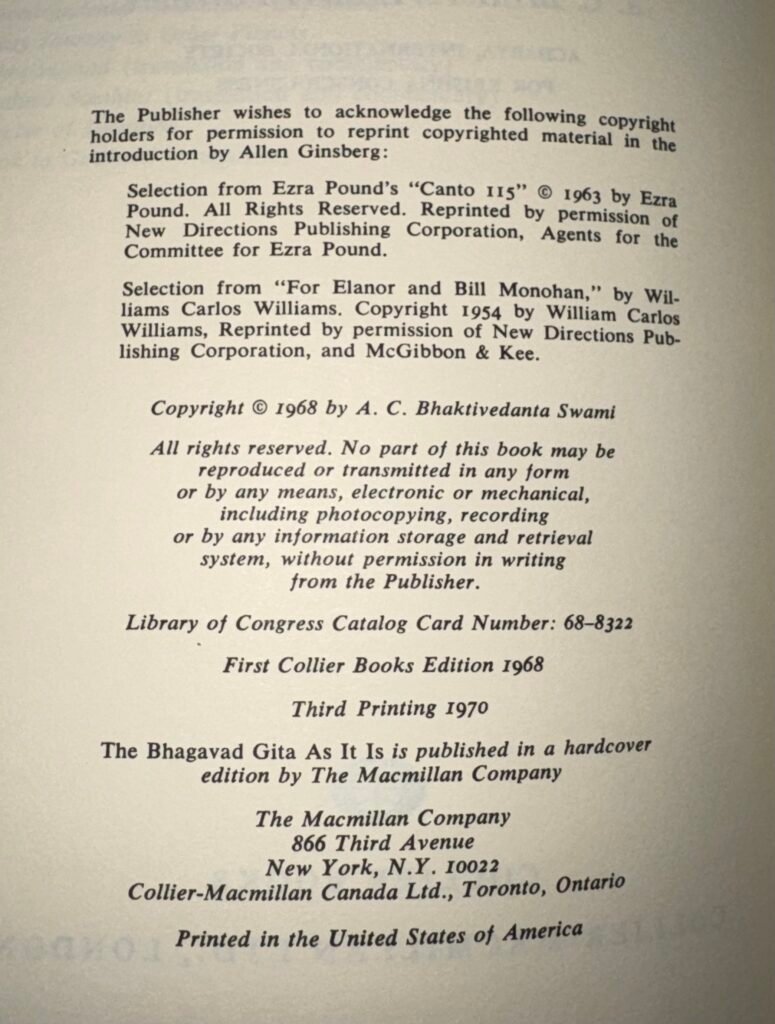
Year of Publication: 1972 (Copyright); 1973 (Actual Fourth Printing date).
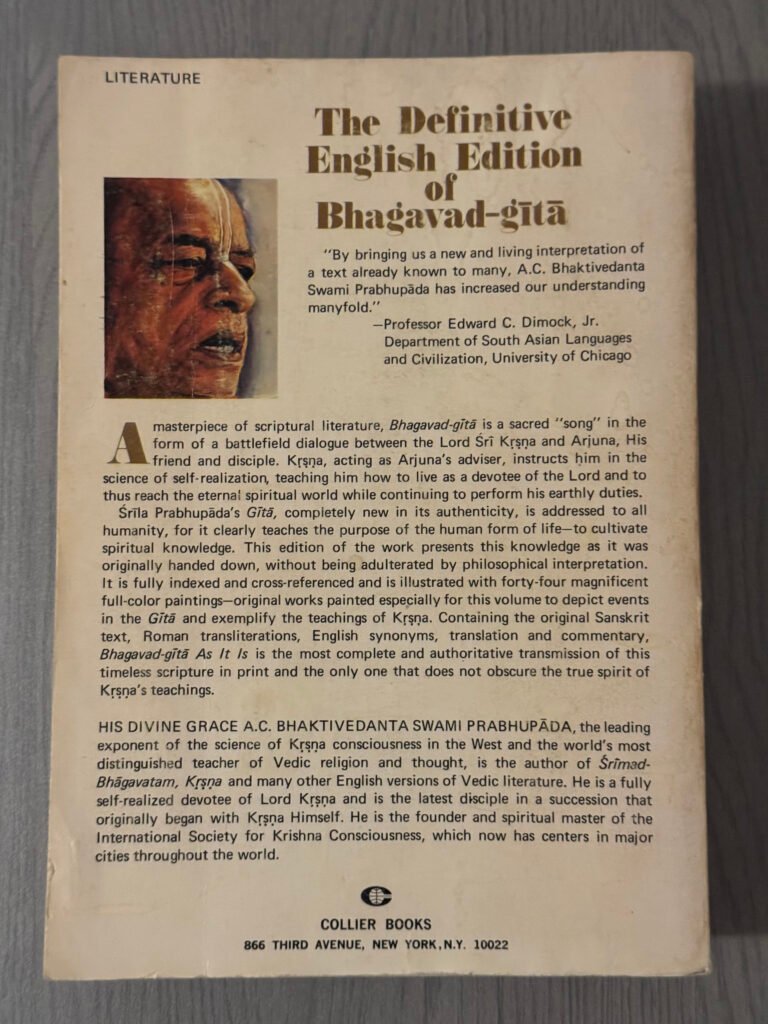
Publisher & Location: The Macmillan Company (New York) / Collier Books.Note: By the 4th printing, the Bhaktivedanta Book Trust (BBT) logo and address (often 3764 Watseka Ave, Los Angeles) began appearing more prominently alongside or in place of Macmillan on the title page.
Edition & Printing State: First Edition, Fourth Printing.
ISBN/LCCN: * LCCN: 72-84882ISBN: 0-02-089130-0 (Paperback) / 0-02-510650-2 (Hardcover)
Physical Description
Binding: Mass-market “softbound” or “trade paperback.”
-
-
-
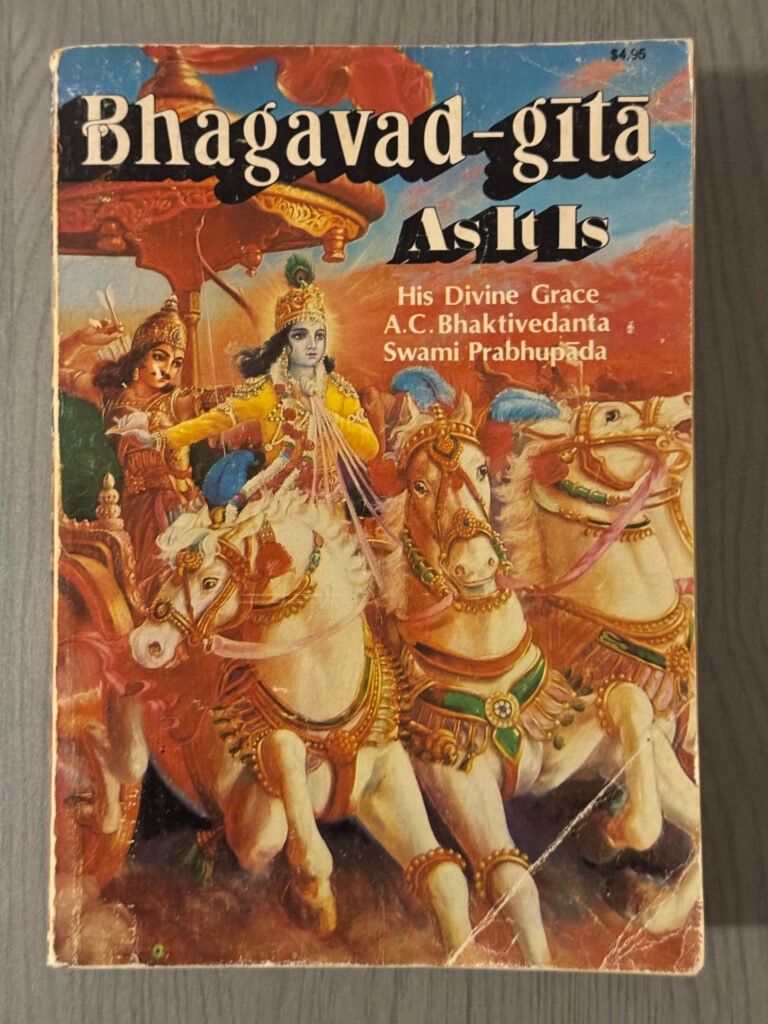
- Visual Point: The 1973 fourth printing often features the iconic glossy yellow/orange cover with the painting of Krishna and Arjuna on the chariot (by Jadurani Dasi).
-
-
-
- Dust Jacket Points: N/A for paperback.
-
- Page Count:1,008 pages (exclusive of front matter and color plate inserts).
-
- Archival Note: This is exactly double the thickness of the 1968 abridged version.
-
- Page Count:1,008 pages (exclusive of front matter and color plate inserts).
-
- Illustrations:48 full-color plates.
-
- Archival Detail: Check that all 48 plates are present; they are usually bound in three or four distinct “signatures” (groups) throughout the book. Disciples credited include Jadurani, Parikshit, and Bharadraja.
-
- Illustrations:48 full-color plates.
Collector “Points” (The “Unique” Value)
-
- Errors/Typos:
-
- The “Pitris” Correction: On page 480 (9.25), the 1973 printing usually retains the correct translation (“ancestors”), whereas some very early 1972 first-printings still had the “planet of the trees” error from the 1968 manuscript.
-
- Index Size: The index in this printing is approximately 80 pages long. (In modern revised editions, this was famously condensed to around 20 pages).
-
- Errors/Typos:
-
- Changes in Artwork: * This edition features the original paintings before they were “digitally cleaned” or replaced in the 1983 revision. The colors in the 1973 printing are often deeper and more “painterly” due to the lithographic process used at the time.
-
- Provenance:
-
- By 1973, the “Hare Krishna” movement was expanding globally. You may find “ISKCON Alachua” or “ISKCON New York” stamps in these copies, marking them as early “distribution” copies used by the first generation of devotees.
-
- Provenance:
“While the 1968 edition was a ‘summary’ for the public, the 1972/73 Complete Edition was the first time the full depth of Srila Prabhupada’s Sanskrit scholarship was available. The fourth printing (1973) is particularly noted by collectors for its sturdy binding, which has often survived better than the fragile glue used in the 1972 first-print paperbacks.”
HISTORY
The history of the 1972 Macmillan Edition of Bhagavad-gita As It Is is a story of persistence, a “publishing miracle,” and a major turning point for the Hare Krishna movement. This edition is often called the “Unabridged” or “Complete” edition because it restored nearly 600 pages of content that had been cut from the earlier 1968 version.
1. The Stolen Manuscripts (1965–1966)
Before the book was ever printed, Srila Prabhupada faced significant setbacks. He had already translated the Gita while in India, but the manuscript—over a thousand pages—was stolen. After arriving in New York in 1965, he started over from scratch, dictating the entire translation and commentary into a tape recorder. In early 1966, his typewriter and recorders were also stolen, but he remained resilient and finished the new manuscript in 1967.
2. The 1968 Abridged Edition (The “Cut” Book)
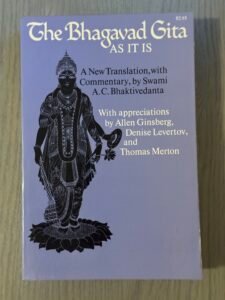
When Srila Prabhupada’s disciples first approached major publishers, many were uninterested, citing a lack of commercial value. Eventually, Macmillan Publishers agreed to take the project—but with a major catch.
- The Abridgement: Macmillan felt the 1,000-page manuscript was too long for a “new” author. They cut the book down to less than 400 pages.
- The Omissions: This version (published in 1968) lacked many of the elaborate “purports” (commentaries), omitted the original Sanskrit verses, and had no illustrations.
- The Result: While Prabhupada was happy to be published by a major house, he was deeply unsatisfied with the “minimized” version of his work.
3. The “Macmillan Miracle” (1970–1972)
As the 1968 edition became a bestseller on college campuses, the demand for a complete version grew. The story of how Macmillan agreed to the larger book is famous among devotees:
- The Delivery: Srila Prabhupada sent his disciple, Brahmananda Dasa, to the Macmillan offices with a specific instruction: “Tell them you are a disciple of a guru from India and he has translated the Bhagavad-gita. They will publish it. Do not worry.”
- The Success: Macmillan’s senior editor was actually looking for a authoritative text to fill their religion section. Impressed by the sales of the abridged version, they agreed to print the unabridged edition.
4. The Landmark 1972 Release
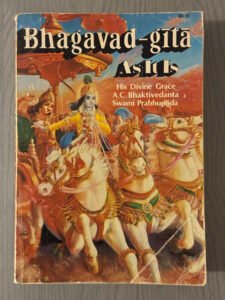
The unabridged edition was published on August 14, 1972. It was a massive 1,008-page hardcover that included:
- Original Sanskrit: Both the Devanagari characters and Roman transliteration.
- Word-for-Word Meanings: A technical breakdown of every Sanskrit word.
- Elaborate Purports: The full, uncut commentaries for all 700 verses.
- 48 Color Plates: High-quality spiritual artwork commissioned specifically for the book.
Why it is “The Standard” Today
For many researchers and “original book” advocates, the 1972 edition is considered the final authorized version because:
- Direct Supervision: Srila Prabhupada personally oversaw the editing (done by Hayagriva Dasa) and the artwork (overseen by Govinda Dasi).
- Unrevised Text: It predates the 1983 “Revised and Enlarged” edition by the BBT, which introduced thousands of grammatical and philosophical changes that remain controversial.
- Academic Acclaim: This specific edition carried glowing reviews from professors at Harvard, Yale, and Oxford, cementing the movement’s intellectual credibility in the 1970s.